E-bikes for trail and errands
Tire width, watt-hours per mile and rack weight decide whether one e-bike can do gravel on Saturday and groceries on Monday.
Updated 2026-09-17
We may earn a commission if you buy through links on this page. It never changes what you pay. How we make money
Most people shopping for one e-bike want it to handle a gravel trail on the weekend and a grocery run on Tuesday, and those two jobs pull in opposite directions: fat tires and suspension for the first, low weight and easy handling for the second. This guide compares two generations of the same fat-tire platform against a belt-drive commuter, which is a useful pairing because the batteries are the same size and almost everything else differs. The deciding numbers are tire width, watt-hours per mile and how much bike you can lift onto a rack.
How to decide
Start with where you are allowed to ride, because that rules out bikes before specs do. The three-class framework used by most states puts pedal-assist-only bikes that stop assisting at 20 mph in Class 1, throttle bikes that stop at 20 mph in Class 2, and pedal-assist bikes that carry to 28 mph in Class 3. Natural-surface trails and many rail-trails allow Class 1 only, and plenty of park systems exclude throttles outright. Both Lacros bikes list a 28 mph top speed with a throttle and neither product page states a class; NIU publishes 28 mph on pedal assist and 20 mph on throttle. Before buying, check whether the display can cap assist at 20 mph, and check your local rule, because a ranger reads the label on the frame.
Tire width is the next filter, and it is simple geometry. A 20 x 4 fat tire is 1.67 times the width of the NIU's 27.5 x 2.4, and at low pressure that extra width spreads your weight over a longer contact patch, which is what keeps a wheel on top of loose gravel, sand and snow instead of cutting into it. A 2.4 inch tire is perfectly happy on packed crushed limestone and pavement and gets squirmy in soft sand. If your trail is a rail-trail, 2.4 is enough; if it is a beach access road or a sandy two-track, it is not.
Then treat claimed range as a ratio, not a promise. All three bikes carry 960 Wh, and a 90 mile claim works out to 960 divided by 90, or 10.7 Wh per mile, which is achievable only with light assist on flat pavement by a rider who pedals. Budget 20 to 25 Wh per mile for real pavement riding with moderate assist, and 35 to 40 Wh per mile for a fat-tire bike on soft ground or heavy throttle use. That turns 960 Wh into about 38 miles mixed and closer to 25 miles on a trail day. For errands the same arithmetic is friendlier: a 6 mile round trip five days a week is 30 miles, or about 750 Wh, so one charge covers a week of groceries.
Finally weigh the bike against your rack, which is where fat-tire bikes lose the errand argument. These three run 70.5, 77.8 and 82 pounds. Many hitch racks are rated for 60 pounds per bike, so all three need an e-bike-rated rack, and two bikes plus a 50 pound rack puts more than 200 pounds on the hitch, at or over the tongue-weight rating on a lot of crossovers. This is the practical reason the NIU wins errands: it is the lightest here by 7.3 pounds against the 2026 Cyclone and 11.5 against the older one, and its two 480 Wh packs come out, so you can carry batteries inside and lift less bike.
One note on names. The older Cyclone is sold as a lightweight commuting bike and is in fact the heaviest of the three at 82 pounds; the weight advantage here belongs to the NIU.
Compared
| Pick | Tires | Battery | Claimed range | Weight | Price |
|---|---|---|---|---|---|
| Lacros Cyclone 2026 | 20 x 4 fat, full suspension | 48V 20Ah Samsung, 960Wh | Up to 90 miles | 77.8 lbs | $1,229.00 |
| Lacros Cyclone | 20 x 4 fat, full suspension | 48V 20Ah Samsung, 960Wh | Up to 90 miles | 82 lbs | $1,059.00 |
| NIU BQi-C3 Pro | 27.5 x 2.4 | Dual 480Wh swappable, 960Wh | 60 to 90 miles | 70.5 lbs | $799.00 |
The picks

Cyclone 2026 - Enhanced All Terrain Electric Bike
Full suspension and 20x4 fat tires suit mixed pavement-and-trail riding, not just paved commuting.
- Motor:
- 750W rated, 1400W peak, 85 N.m brushless rear hub motor
- Battery:
- 48V 20Ah Samsung, 960Wh
- Claimed range:
- Up to 90 miles
- Weight:
- 77.8 lbs (35.3 kg) with battery
About $1,229.00 (checked 2026-09-17)
Check price at LacrosThis is the trail-first pick, and the refresh is mostly about the parts you touch: Lacros lists a lower, more compact frame for balance and control, an upgraded display, redesigned lighting and a reworked cockpit, alongside UL certification. Mechanically it is the same 960 Wh Samsung pack and the same 750 W rated hub motor as the older bike, now quoted at 85 N.m of torque, and it is 4.2 pounds lighter at 77.8 pounds. What it gives up is $170 over the outgoing model and any pretense of being easy to rack. Buy it if the weekend ride is real gravel and the errands are short.
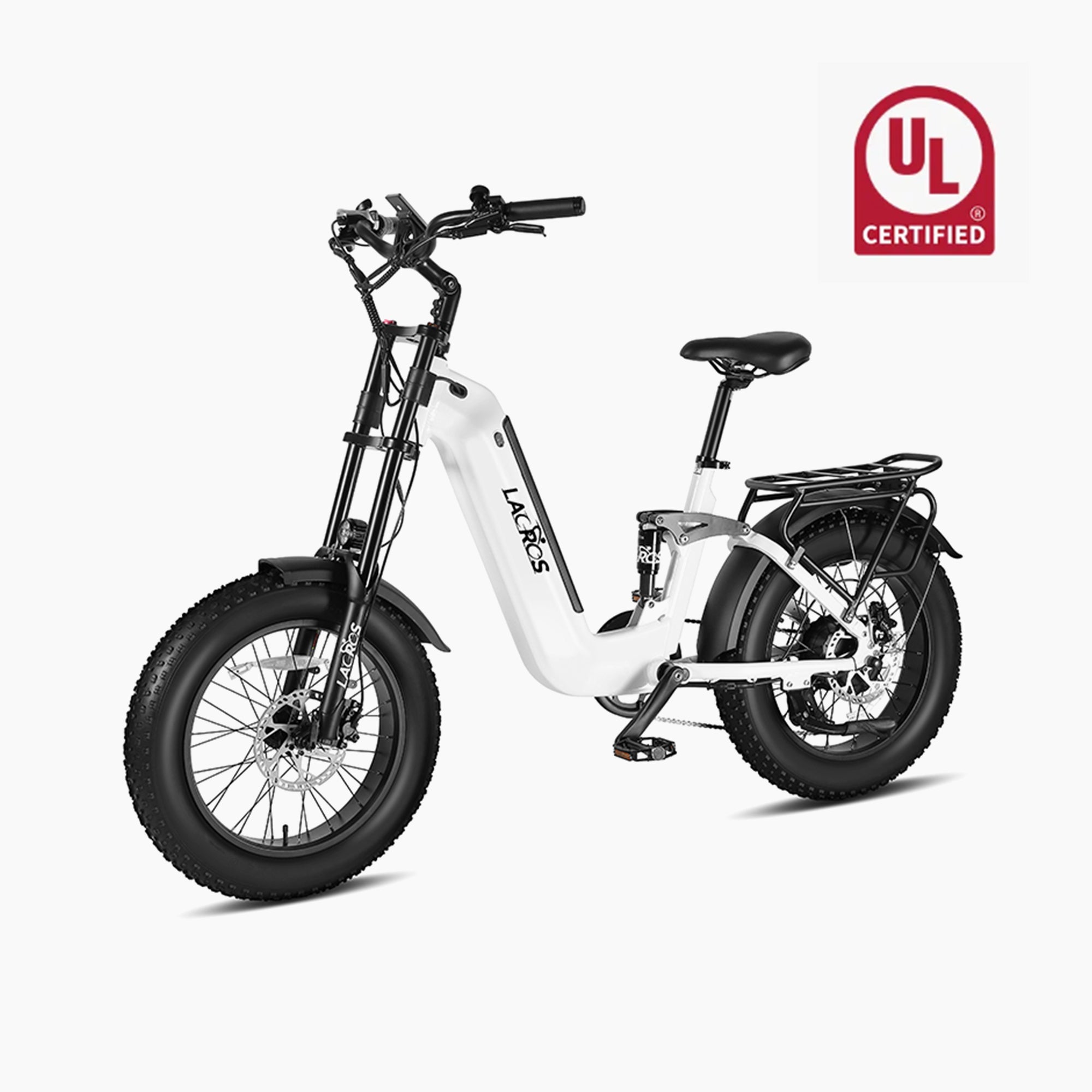
Cyclone - Lightweight Electric Bike for Commuting
The extra-long step-through frame suits an easy mount and dismount for everyday errands rather than trail riding.
- Motor:
- 750W rated, 1400W peak brushless rear hub motor
- Battery:
- 48V 20Ah Samsung, 960Wh
- Claimed range:
- Up to 90 miles
- Weight:
- 82 lbs (37.2 kg) with battery
About $1,059.00 (checked 2026-09-17)
Check price at LacrosThe outgoing Cyclone is the value version of the same idea: identical 48V 20Ah Samsung battery, the same 1400 W peak motor, the same 20 x 4 tires and full suspension, with a 7 inch step-through frame that is genuinely easier to mount than a top tube when you are carrying a bag. At $1,059.00 it saves money for the same range claim. What it gives up is the 2026 frame, display and lighting updates, and 82 pounds makes it the heaviest bike here, which you feel every time it comes off a rack. Choose it if you want fat tires for the least money and the bike lives in a garage, not on a car.
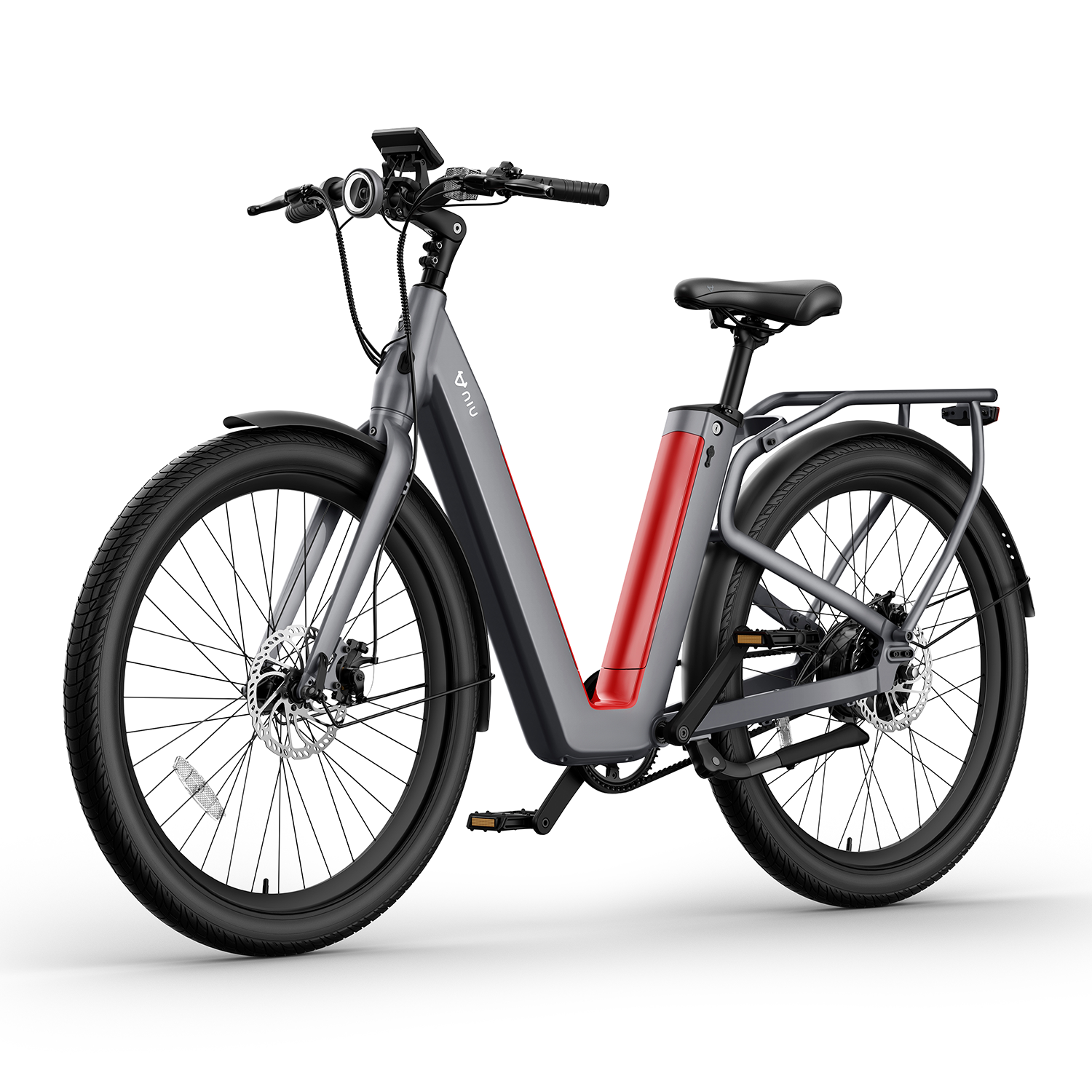
NIU BQi-C3 Pro E-Bike
Swappable dual batteries suit a rider who needs 60+ miles of range without carrying one oversized pack.
- Motor:
- 500W rated / 750W max hub motor
- Battery:
- Dual 480Wh swappable batteries (960Wh total)
- Claimed range:
- 60-90 miles per charge
- Weight:
- 70.5 lbs
About $799.00 (checked 2026-09-17)
Check price at NIUFor errands this is the one. Two 480 Wh packs add to the same 960 Wh the Lacros bikes carry, but they come out individually, so the bike is 70.5 pounds at its heaviest and lighter still with the batteries in your hand, and you can charge one indoors while the other rides. The Gates carbon belt drive and single-speed setup mean no chain to oil and nothing to adjust, which is what you want on a bike used for 6 mile trips in work clothes, and 27.5 x 2.4 tires roll faster on pavement than any 4 inch tire will. What it gives up is soft ground and travel: no suspension, mechanical rather than hydraulic disc brakes, and a 287 pound payload limit that a heavy rider plus a full trailer could reach.
What we'd skip
We would skip any e-bike whose listing will not name the battery cell supplier or a safety certification such as UL 2849 for the electrical system or UL 2271 for the pack. Those bikes exist at every price, often with a 48 V pack of unnamed cells and no charging documentation, and the risk is not range, it is a battery charging in your garage. All three bikes here are specific about the pack, which is the minimum bar for something you store indoors.
FAQ
what class of ebike is allowed on trails
Most natural-surface and multi-use trail systems allow Class 1 only, meaning pedal assist with no throttle and assistance ending at 20 mph, while Class 2 throttle bikes and Class 3 bikes assisting to 28 mph are usually limited to roads and paved paths. Rules vary by land manager, sometimes trail by trail. If a bike can be set to cap assist at 20 mph and disable the throttle, it has a better chance of being ridable where you want.
how far can a 960wh ebike battery really go
A 90 mile claim implies 10.7 Wh per mile, which is a flat-road, light-assist, strong-pedaling number. Real use runs 20 to 25 Wh per mile on pavement and 35 to 40 on soft ground or heavy throttle, so expect about 38 miles mixed and 25 on a fat-tire trail day. Cold weather, headwind, hills and cargo all move it down.
can you put an ebike on a regular bike rack
Often not. These bikes weigh 70.5 to 82 pounds and many hitch racks are rated to 60 pounds per bike, so you need a rack rated for e-bikes, ideally with a ramp. Also add it up before you buy: two bikes plus a heavy rack can exceed 200 pounds of tongue weight, which is more than some crossover hitches allow.
Specs and prices come from each retailer's product page on the date shown on the card. This is a research-based comparison, not a hands-on test.
Products in this guide
- Cyclone 2026 - Enhanced All Terrain Electric Bike — Lacros
- Cyclone - Lightweight Electric Bike for Commuting — Lacros
- NIU BQi-C3 Pro E-Bike — NIU